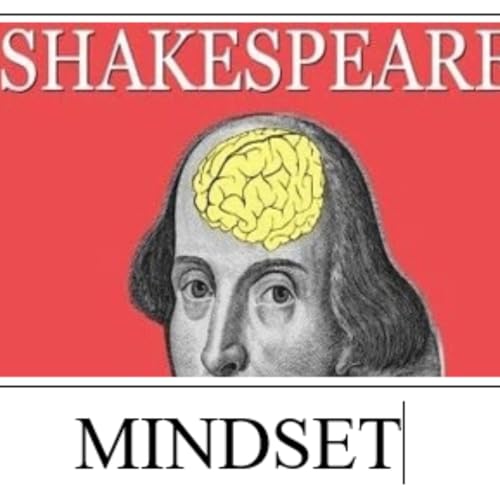
『The Shakespeare Mindset: Improve your life the Bard way not the hard way』のカバーアート

The Shakespeare Mindset: Improve your life the Bard way not the hard way

The Shakespeare Mindset: Improve your life the Bard way not the hard way

著者: Dave Cohen
無料で聴く

Stuck in a rut? Scared of change? Stressed about the world? Anxious for yourself and your loved ones? Know what, more than 400 years ago everyone felt the same way only without the comfort of light bulbs, central heating and sticky toffee pudding. William Shakespeare wrote about it all - and offered many answers to all kinds of modern questions such as what can we do to conquer our fears, how do we find true love and what does it mean to be human? He also asked: to be or not to be? We're still working on that one. My name's Dave Cohen - comedian, author and Horrible Histories lyric writer turned Shakespeare fanboy and I'm here to tell you that there are only two ways to deal with life's problems - the hard way or the Bard way.

Hosted on Acast. See acast.com/privacy for more information.

Dave Cohen
個人的成功 哲学 社会科学 自己啓発
エピソード
  • Here's The Knight In Shining Armour Come To Save Us
    2026/06/30

    "That tragedy from which she rescues him gratuitously for the sake of their mutual welfare."


    Once upon a time there was a bad man who ruled the kingdom, and the people were unhappy. Just when everything seemed lost a knight in shining armour arrived, the kingdom was saved and we all lived… well most of us did. Who is this mysterious new character in our lives? What are the chances that in the wake of his arrival, we all live happily ever after? Are we possibly getting a bit old to believe fairy stories?


    In this week's episode I look at one of the oldest fairy tales in English folklore, that first found its way into the stories of King Arthur and the Knights of the Round Table, recorded almost a thousand years ago. In a previous episode I talked about the ways in which we become disappointed very quickly with our new leaders, today we're taking a step further back as we investigate what happens in the build up to getting rid of the bad guy and replacing them with the knight in shining armour.


    The reason these stories remain so popular is because they still resonate for us in the 21st century, It’s not difficult to see ourselves in each of the main characters in this story. You and I and almost everyone is the poor beautiful young princess, yes even me, a 67-year-old white bloke with hairy legs and an occasional weight problem.

    The bad ruler, or ugly sister, or wicked stepmother represents a person we know who seems to have too much control over our lives. The knight in shining armour, in the fantasy that is this story, is the handsome young Amazon driver, here to deliver that control back to us.


    Yes it’s a story, as believable as the fairies at the bottom of the garden who tell it. In reality more often than not it’s the lesser evil who still controls our lives but in a slightly less controlling way.


    There are many ways in which Shakespeare approaches the story - there's the person who thinks they're the knight when they're clearly knot (sorry), sometimes there's more than one knight battling for the honour of the title, sometimes we just like the idea of a knight, other times there really is a knight but they don't win, and then there's the world where there's no such thing.


    Is it all a bunch of fairy stories, a waste of time? Well, occasionally we really do all live happily ever after.

    Hosted on Acast. See acast.com/privacy for more information.

    続きを読む 一部表示
    23 分
  • Why Laughter Is Even Better Than The Best Medicine
    2026/06/23

    "The fool doth think he is wise, but the wise man knows himself to be a fool."... "They laugh that win"


    In this episode I talk to my former Sitcom Geeks co-host James Cary. James is one of the most successful audience sitcom writers in the UK, having worked on a host of TV and radio audience shows including Miranda, My Hero, Think The Unthinkable and My Family. His own show Bluestone 42 ran for three series on the BBC. Together we nerded out for 222 episodes about all matters sitcom.


    We stopped making the show in 2023, in the time since I've become obsessed with Shakespeare, but have also come to understand how so much of the audience TV show, my favourite form of comedy, owes its debt directly to the plays of Shakespeare. I thought I might struggle to persuade James of this latest theory but it turns out that he has his own favourite Shakespeare obsessions as well.


    In this, the first part of the interview, we talk about what an audience sitcom is and how it sits as a direct descendant of the old English music hall and the plays of Shakespeare. We talk about what we love about audience sitcom ("I like laughing" is James's excellent answer to the question), and how this relates to some of the best aspects of Shakespeare - including the feeling engendered by being in the room when the show is happening.


    We discuss how flawed characters are at the heart of the best sitcoms, and talk of how this is also true in a lot of Shakespeare.

    Hosted on Acast. See acast.com/privacy for more information.

    続きを読む 一部表示
    36 分
  • Why Is There So Much Rage?
    2026/06/16

    "I understand a fury in your words, / But not the words."

    Why is there so much rage in the world? Since I started making this podcast I have forced myself back to social media, in case you’re wondering why I reached that earth shattering conclusion. I left because I’d been wondering why my mental health seemed to have been deteriorating slightly and as soon as I stopped, it got better. Simplest experiment ever undertaken.


    Anyway I came back to facebook because they have millions of fans following several Shakespeare pages and I thought ‘these are my people’, not realising that I’d still be getting the feed from friends I used to follow three years ago. And you know what? They’re still posting exactly the same enraging stuff they were posting back then.


    Every now and then some new invention comes along that brings deep disorder to the world. It took around 10 years for the iPhone to revolutionise our lives, and turn us all into a giant universe of hunched miniature screen starers. Things moved a little slower in Shakespeare’s time but around a hundred years after Johannes Gutenberg had invented the printing press in 1440 it began to disrupt… well, everything. Like Steve Jobs the man was revered and reviled in equal measure.


    There was no shortage of rage in Shakespeare’s time. And boy did that man know how to write it in a scene.


    In this episode I look at the many aspects of rage and how Shakespeare shows it in the plays. There’s the performative rage of Henry V, proving that rage isn’t necessarily a moment of spontaneous fury, you can learn to switch it on in a moment. There’s nothing performative about Coriolanus. This man is a simmering cauldron of indignation, but it’s okay because that’s exactly what is needed for his chosen profession of soldier. His character trait that’s perfectly admirable in war isn’t quite such an asset in a politician.


    But this episode isn’t all about kings and leaders. What about us. Like Coriolanus, we learn a lot about who we become from the actions of our parents.

    There are many more ways in which rage can be triggered. So many possibilities out there. Whatever flips your switch, it’s almost always something that is caused by factors over which you no longer have any control. Or maybe you always had control and never realised until you lost it, possibly on account of your own stupid actions, you damn fool.


    That’s you, King Lear, and also, if I admit it, me too. How? Listen on…

    Hosted on Acast. See acast.com/privacy for more information.

    続きを読む 一部表示
    26 分
adbl_web_anon_alc_button_suppression_t1
まだレビューはありません