

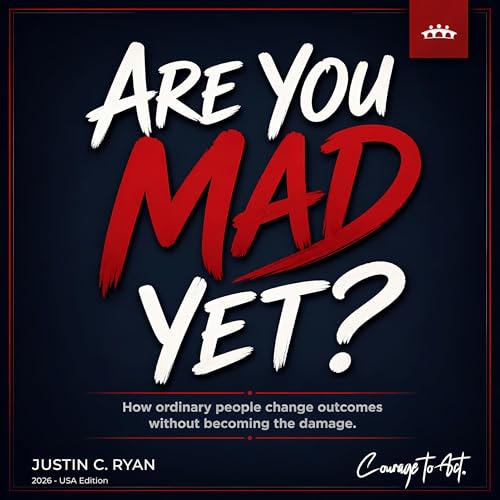
Are You Mad Yet?
How Ordinary People Change Outcomes without Becoming the Damage.
カートのアイテムが多すぎます
カートに追加できませんでした。
ウィッシュリストに追加できませんでした。
ほしい物リストの削除に失敗しました。
ポッドキャストのフォローに失敗しました
ポッドキャストのフォロー解除に失敗しました
聴き放題対象外タイトルです。Audibleプレミアムプラン登録で、非会員価格の30%OFFで購入できます。

Are You Mad Yet?
¥2,110 で購入
-
ナレーター:
-
Hopper Stone
-
著者:
-
Justin Ryan
Are You Mad Yet? How Ordinary People Change Outcomes Without Becoming the Damage. Something feels off. You can sense it in the headlines, in the conversations you've stopped having, in the exhaustion that's started to feel like peace. If you've been quietly swallowing the slow erosion of trust, the normalization of cruelty dressed up as policy, and the creeping suspicion that the ground is shifting beneath everything familiar, this book is for you.
Are You Mad Yet? is not a call to rage for the sake of noise. It's an invitation to notice what you've been pretending not to see, and a practical guide for doing something about it without losing yourself in the process.
Drawing on more than a decade in the U.S. Air Force and years of senior leadership in cyber risk and governance inside global financial institutions, Justin C. Ryan brings a systems thinker's eye to democratic erosion, media manipulation, and institutional fragility. He decodes the authoritarian playbook, shows you how to spot it in real time, and offers a framework for shaping your anger into something clear, grounded, and useful.
This is a mirror and a map. A mirror to reflect how power actually moves in the modern world, and a map that shows where small, human choices still matter. You don't need to become an activist, abandon your life, or burn everything down to be part of what comes next. You only need to be honest about what you see and courageous enough to stop pretending it doesn't affect you.
With chapters on choosing your lane, applying pressure without becoming the damage, holding the line when things get harder, and what history actually shows us about change, Ryan offers context, language, and restraint for a moment that desperately needs all three.
Because the opposite of madness is not silence or compliance. It is awareness, shared responsibility, and the quiet decision to stop looking away.
©2026 Justin C. Ryan (P)2026 Justin C. Ryan